The Quick Answer (Then the Real One)
Yes, you can run wood floors under kitchen cabinets — but only when the floor is stapled down or glued down.
If your floor is floating, cabinets must go in first and the flooring installs around them with proper expansion gaps.
This topic creates confusion because kitchens can use multiple installation methods.
Homeowners hear “wood floors under cabinets looks premium” (true), and then someone else says “never do that, it’ll buckle” (also true… for floating floors).
The missing piece is the method.
At LUKS Construction, we install and refinish hardwood floors across Seattle and the Eastside. We’ve seen what happens when the timeline is planned correctly — and we’ve been called in to fix the aftermath when it isn’t.
Let’s make sure you land on the right side of that story.
At LUKS Construction, we install various types of hardwood flooring and can help you choose the best option for your home. Our experience shows that well-installed hardwood flooring can last for decades.
First: Pick Your Installation Method
You can use multiple wood-floor installation methods in kitchens, but only stapled and glued floors can be permanently affixed underneath fixed cabinetry and kitchen islands.
Floating floors require an expansion gap around all perimeters and fixed objects so the floor can move naturally.
Best for cabinets on top
Staple-Down or Glue-Down Installations
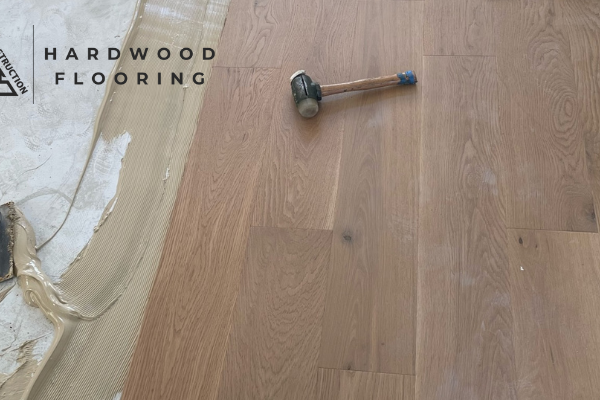
When your floors are stapled or glued to the subfloor, they’re fully secured. They don’t “float” on underlayment and they don’t depend on an expansion gap around cabinetry the way floating floors do.
This means:
- Floors can safely run underneath fixed cabinetry and kitchen islands.
- Cabinets can be installed directly on top of the flooring.
- No additional trim is required at the base of cabinets (a cleaner look).
- For open-concept layouts, you can achieve seamless, continuous flooring through the kitchen.
Choosing the right hardwood flooring also involves considering the type of wood, finish, and installation method that best suits your needs.
Interactive check:
If you plan to remodel cabinets in the next 10–15 years (very common in Seattle-area homes), installing wood wall-to-wall first can save you from
mismatched patch work later.
Cabinets first
Floating Installations (Engineered / Laminate / LVP)
Floating floors aren’t attached to the subfloor. The planks lock together and rest over underlayment.
Because the entire system moves as one “sheet,” it requires an expansion gap around walls and fixed objects.
Floating hardwood flooring is a popular option, but it’s essential to understand its limitations compared to glued or stapled flooring.
For floating floors:
- Floors should not run underneath cabinets, islands, or permanent fixtures.
- Cabinets must be installed first and anchored to the subfloor.
- Flooring is installed up to the cabinets, leaving the correct expansion gap.
- Trim is added after to conceal the gap — shoe molding is typically cleaner than quarter round.
Installing cabinets on top of a floating floor can restrict movement and lead to buckling, separation, and long-term damage.
It can also impact manufacturer warranty coverage, depending on the product.
Picture this:
Your floating floor expands during a damp Seattle winter… but the cabinets pin it down in the center.
The pressure has to go somewhere — and it usually shows up as a hump, a lifted seam, or a “pop” you feel underfoot.
So… Should You Run Wood Floors Under Kitchen Cabinets?
Here’s the honest, contractor-level answer:
It depends on the floor system, your remodel plans, and your timeline.
But once you know the rules, the decision becomes simple.
For kitchens, staple-down or glue-down hardwood flooring is often recommended for its longevity and stability.
| Floor Type / Method | Can cabinets sit on it? | Best practice |
|---|---|---|
| Solid hardwood (staple-down) | Yes | Install flooring first; cabinets on top; plan expansion at walls. |
| Engineered hardwood (glue-down) | Usually yes | Flooring first; cabinets on top; use correct adhesive & moisture strategy. |
| Engineered hardwood (floating) | No | Cabinets first; floor around; expansion gap + shoe molding. |
| LVP / laminate (floating) | No | Cabinets first; floor around; never pin a floating system. |
Why This Matters in Seattle & the Eastside
Kitchens in Seattle-area homes rarely stay “final” forever. Styles shift quickly, and homeowners update cabinets more often than they expect.
If your flooring only exists around the cabinet footprint, future changes can trigger a chain reaction:
patching, color mismatch, discontinued product searches, and awkward transitions.
On the other hand, installing a glue-down or staple-down wood floor wall-to-wall can feel like overkill on day one —
until the day you swap cabinets, move an island, or redesign the layout and realize the flooring is already done.
Installing the right hardwood flooring helps avoid costly repairs and enhances the overall look of your kitchen.
A real-world scenario we see all the time
With the right care, hardwood flooring can maintain its beauty and functionality for years to come.
A homeowner remodels a kitchen in Bellevue. Cabinets go in first. Flooring is cut around them.
Everything looks fine… for a while.
Then, years later, they decide to replace cabinets or change the island shape. Once the old boxes come out, there’s a surprise:
bare subfloor and missing flooring in the old cabinet footprint.
Matching the old wood — same species, grade, width, and finish — is rarely simple. Sometimes it’s not possible at all.
That’s when “saving money” on the first remodel becomes an expensive second remodel.
Planning Your Kitchen Renovation Timeline
Planning ahead for your hardwood flooring installation will ensure a smooth renovation process.
Before installation begins, confirm your flooring method with your installer and coordinate the order of operations.
A simple conversation early on can prevent costly changes later.
General rule
Consider how your hardwood flooring choice will impact the overall design and functionality of your kitchen.
- Stapled or glued floors: floors first → cabinets on top.
- Floating floors: cabinets first → flooring around + expansion gap.
Kitchen timeline checklist (save this)
- Choose the floor type (solid vs engineered vs LVP) and the method (glue/staple vs floating).
- Confirm subfloor condition (flatness, moisture, squeaks, repairs).
- Plan the cabinet layout, island footprint, appliance locations, and any floor vents.
- Decide installation order based on the method.
- Set expectations for trim (shoe molding vs minimal base detail), if needed.
- Schedule finish coats / cure time if refinishing or site-finishing new hardwood.
Not sure which method you’re getting?
If you’re hearing terms like “floating,” “click-lock,” “glue-down,” “staple-down,” and it’s starting to blur together — that’s normal.
Tell us your flooring product and kitchen plan, and we’ll help you choose the correct sequence.
What About Kitchen Islands?
Islands are where mistakes happen most often — because they’re heavy, fixed, and typically anchored.
The rule follows the same logic:
glued/stapled floors can go under an island, but floating floors should not be pinned under island weight.
Proper installation of hardwood flooring under islands can help maintain stability and prevent issues later.
Practical guidance:
- Glue-down or staple-down wood floors: island can typically be installed on top.
- Floating floors: island should be secured to the subfloor; flooring should expand around it with a concealed gap.
If someone suggests placing a heavy island on a floating floor “because it’s easier,” treat that as a red flag.
It often becomes a callback later.
The Look: Seamless vs Trimmed Base
Aesthetics are part of the decision too. When floors run under cabinets (glued/stapled installs), you get a cleaner base with fewer visual lines.
When floating floors run around cabinets, the trim can still look great — but it has to be planned intentionally.
The choice between seamless hardwood flooring and trimmed base can affect the visual appeal of your kitchen.
Trim tip (from our finish carpentry playbook)
If you need trim at the cabinet base, choose shoe molding instead of quarter round.
It’s slimmer, more modern, and less “busy” visually — especially with contemporary flat-panel cabinetry.
Common Mistakes to Avoid
- Installing cabinets on floating floors: restricts movement and can cause buckling or gaps.
- Skipping expansion gaps: wood moves — kitchens amplify that movement.
- Not coordinating installers: cabinet crew and flooring crew must agree on sequence.
- Ignoring subfloor flatness: especially important for click-lock systems.
- Last-minute changes to island footprint: can expose or compress flooring unexpectedly.
FAQ: Cabinets & Wood Floors
Is it “better” to run hardwood under cabinets?
Running hardwood flooring wall-to-wall can create a cohesive look and simplify future renovations.
For glue-down or staple-down hardwood, running floors wall-to-wall can be a premium, future-proof approach.
It supports seamless design and reduces headaches if cabinet layouts change later.
For floating floors, it’s not better — it’s risky. The “better” choice is the method that respects movement.
Will cabinets damage hardwood floors?
Understanding the benefits of different hardwood flooring systems will help you make an informed decision.
Cabinets can sit safely on glued/stapled wood floors when installed correctly. The key is planning expansion at the room perimeter,
controlling kitchen moisture, and coordinating fastening so the floor system performs as designed.
Can I still use floating floors in a kitchen?
Yes. Floating floors can look amazing in kitchens when installed correctly. The key is the timeline:
cabinets go in first, then flooring installs around them with proper expansion gaps, and a clean trim detail covers the gap.
What if I want a seamless look but I chose a floating floor?
Choosing an appropriate hardwood flooring option can enhance the beauty of your kitchen and add value to your home.
You can still achieve a refined look. Use slim shoe molding color-matched to the cabinets, keep expansion gaps consistent,
and ensure clean transitions. If a truly seamless look is the priority, consider a glue-down engineered hardwood option instead.
If you’re unsure about the best type of hardwood flooring for your kitchen, our experts can guide you through the options.
Final Takeaway
Stapled or glued wood floors: you can run flooring under cabinets for a seamless, future-proof kitchen.
Floating floors: cabinets must be installed first, then flooring goes around with expansion gaps and clean trim.
If you want, send us your floor product (or a link) and a quick kitchen plan. We’ll tell you the best sequence and what to watch for —
so your new kitchen stays beautiful, stable, and ready for the next chapter.
Ready to plan it the right way?
LUKS Construction — premium hardwood floors installation & refinishing, stairs, tile, showers, and heated floors across Seattle & the Eastside.
© LUKS Construction • Seattle & Eastside Flooring Contractor • Phone: 425-971-2895